
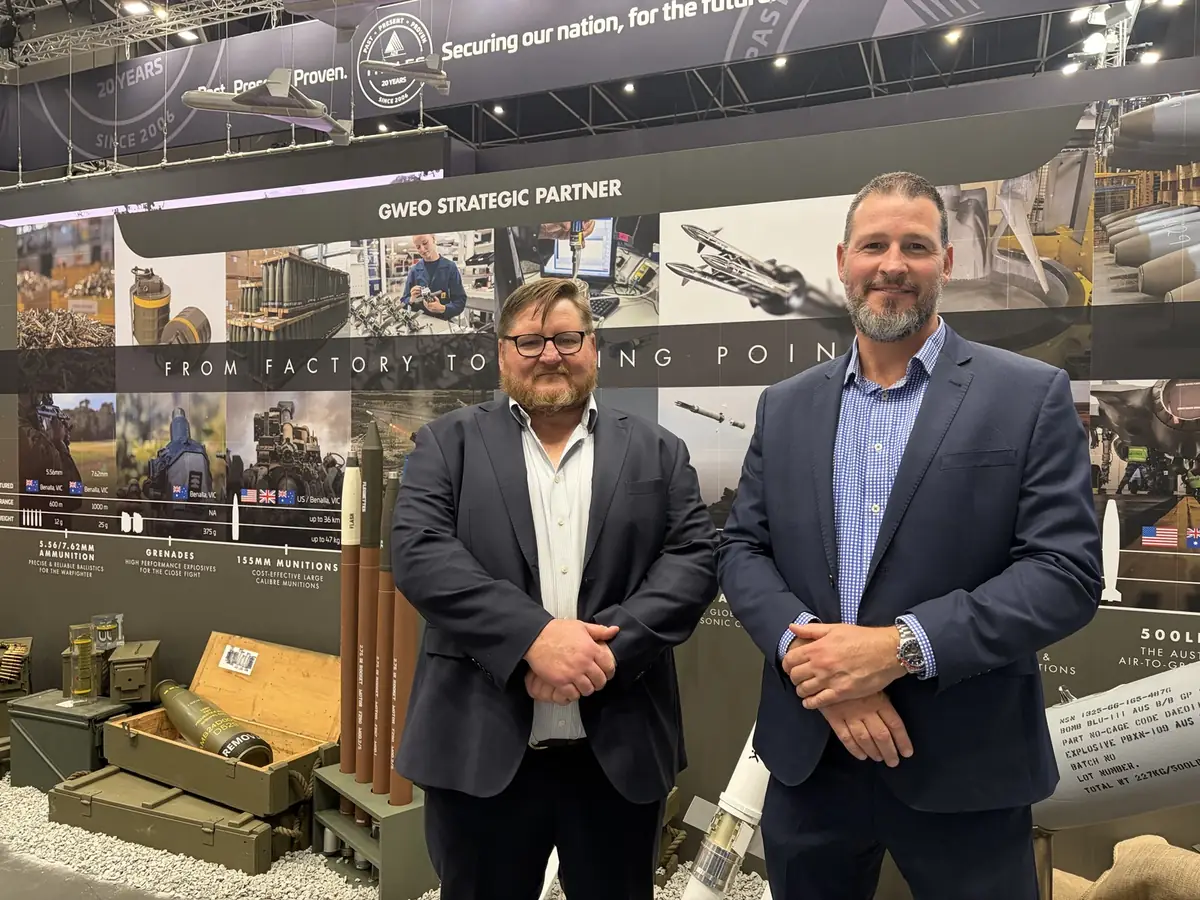
At Land Forces 2026, the question was rarely whether Defence needs digital logistics capability. It was how to get it into service. Australia does not have an innovation problem. It has a problem transitioning proven innovation into operational capability, and closing that gap starts with treating the digital thread as an acquisition requirement rather than an afterthought.
Over three days in Perth, our team ran 16 briefings a day from the Thales Australia stand, alongside the Bushmaster and Blade Haul. We barely left the stand. We spoke with senior Defence leaders, capability managers, logisticians, operational personnel and industry partners, and tailored every demonstration of ReadyFleet™ to the person in front of us.
By the end of the week, one conversation stood out above the rest.
The conversation we kept having
Again and again, we came back to the disconnect between Defence recognising the need for digital logistics capability and actually acquiring and fielding it.
Nobody needed convincing that the need is real. Across every level we spoke to, there was a consistent understanding that future operations will require much better visibility of equipment, supplies, condition, configuration and availability, particularly when communications and supply chains are contested.
What has changed is how defence logistics is talked about. Not long ago, conversations about logistics digitalisation centred on efficiency, inventory management, reporting and reducing administrative workload. Those things still matter, but the questions now are about what happens when communications fail, supply chains are interrupted, platforms are dispersed and commanders cannot rely on the systems they would normally use. Logistics is increasingly seen as an operational vulnerability, and equipment availability and sustainment endurance as direct contributors to combat power.
Army’s priorities reflect that shift. There was considerable interest in contested logistics, autonomous systems, equipment readiness, predictive maintenance, ammunition visibility, interoperability and operating with degraded communications. None of these stand alone. Autonomous vehicles still need maintenance, energy, spare parts and sustainment. Long-range fires need ammunition and reliable supply chains. Distributed forces need accurate information without depending on continuous connectivity to enterprise systems.
Our discussions with industry, including Thales, Lockheed Martin, Hanwha, Kongsberg and Rheinmetall, pointed the same way. Army is investing in increasingly sophisticated platforms, and the logistics systems supporting them need to become equally sophisticated. That means connecting these technologies into an integrated operational and sustainment architecture, designed around information sharing, interoperability and operational outcomes rather than individual platforms or software applications. Too often, they are still treated as separate acquisition projects.
For all the agreement on the problem, one thing has barely moved: the pathway to acquire and field the solution.
“Australia does not have an innovation problem. It has a problem transitioning proven innovation into operational capability.”
A requirement Defence already understands
The requirement for digital logistics is not new, and it has not suddenly emerged from recent discussion about contested logistics. Defence has been examining logistics digitalisation, asset visibility, condition monitoring and integrated sustainment for many years.
We heard the same undertone at the Land Environment Working Group in August, where the case for a Modular Logistics Distribution System was made once again, years after it was first raised. We have had the same conversation directly with Head Defence Capability, Head Land Capability and Joint Logistics Command, who have confirmed that the underlying requirement continues to exist. Land Forces reinforced it again.
But recognising a requirement is not the same as delivering a capability. There is a substantial difference between demonstrating technology, running another trial and putting a capability into sustained operational service. Defence continues to invest in identifying and validating requirements without an effective pathway to field solutions that have already shown their value. The requirement is not waiting for another technology breakthrough. It is waiting for an acquisition and transition decision.
Proven, not theoretical
That is what makes the gap so frustrating. The technology is not hypothetical.
Hammerstone has spent more than a decade working with Defence to develop exactly this kind of capability. At Project Convergence Capstone 5 in the United States in 2025, ReadyFleet™ delivered a logistics common operating picture and in-transit visibility capability supporting the Australian, British and US armies, including integration with enterprise resource planning (ERP) and battle management systems (BMS).
The value there was not simply putting information from different sources on a screen. It was showing how logistics information can be shared to build a common understanding across coalition partners, in a relevant Defence environment rather than a lab.
So Defence needs to spend less time rediscovering the requirement and more time deciding how to transition capabilities that have already been developed and demonstrated. And if the capability exists, the obvious question is where it gets lost. More often than not, the answer is at handover.
Where the digital thread breaks
The digital thread most often breaks at the interfaces between acquisition, platform delivery, sustainment and operations.
During acquisition, a great deal of information is developed about a platform’s configuration, reliability, maintenance requirements, technical documentation and support arrangements. That information is not always delivered in a form the people and systems sustaining the equipment can use. It may sit in separate databases, proprietary applications, documents or contractor-managed systems. By the time the platform enters service, Defence can find itself reconstructing information that should have been there from the start.
We have seen this repeatedly through our involvement in Defence acquisition and sustainment programs, including our Integrated Product Support work. Information requirements are recognised early in a program, then progressively reduced, deferred or removed as cost, schedule and scope pressures build. The consequences land on the people who operate and sustain the equipment, and the information is far more difficult and expensive to recover later.
Fixing it sits across Defence and industry, but the roles differ. Defence must establish and enforce the overarching requirement. Primes need to deliver accessible, interoperable data and support the digital lifecycle of their platforms. SMEs bring specialist technology, integration capability and new solutions, but they cannot solve a structural problem if acquisition contracts do not require the information to be delivered or made accessible. Digital continuity has to be an acquisition requirement, not an aspiration left for the sustainment organisation to resolve.
That is the one message I would want every program manager to take from our stand: stop treating digital logistics as something that can be added after a platform enters service. The digital thread should begin when equipment is acquired and run through configuration management, maintenance, sustainment, deployment and eventual disposal. A vehicle, weapon system or piece of equipment that enters service without the ability to share accurate information about its identity, configuration, location, condition and availability is another information problem someone will eventually have to solve. Establish digital logistics requirements early, protect them through acquisition, and make interoperability a contractual requirement.
“Do not acquire a twenty-first-century military platform with a twentieth-century logistics information system.”
Sovereign capability has to end in procurement
The same gap between intent and delivery shapes Australia’s sovereign capability.
Sovereign capability is about retaining the ability to develop, adapt, maintain and control technologies that matter to Australia’s national security. It does not mean manufacturing every component here, or avoiding international partners. It means not becoming entirely dependent on overseas suppliers for capabilities that are operationally critical.
Australian SMEs bring specialist expertise, responsiveness, innovative technology and an understanding of Defence’s operational requirements, and they are an important source of sovereign intellectual property. Hammerstone is a case in point. We have invested more than a decade developing engineering and digital logistics capabilities, including ReadyFleet™, and worked closely with Defence to demonstrate them. Our challenge has never been technical capability or engagement with Defence. It has been turning that investment into an enduring acquisition outcome.
Larger primes have an essential role in integrating complex defence systems, managing major programs and supporting global supply chains. The opportunity is for Australian SMEs to contribute genuine technology and intellectual property alongside them, rather than being confined to labour supply or low-value subcontracting. But those relationships have to lead to actual procurement. A sovereign capability that Defence helps develop but never acquires is not a sustainable sovereign industrial capability.
The same principle applies to the alliance. As Australia deepens its operational integration with the United States and United Kingdom under AUKUS, future operations will depend on common information standards, interoperability and the secure exchange of logistics information across equipment and systems from many countries. AUKUS Pillar II should be an opportunity for Australian-developed technology to be adopted by our allies, not just another mechanism for buying overseas systems. Interoperability must work in both directions. Australia should contribute technology to the alliance, not just consume it.
Walk any Defence exhibition floor and you will see why this matters. It is full of credible, impressive technology: autonomous systems, advanced sensors, artificial intelligence, digital twins, predictive maintenance platforms and command-and-control solutions. But operational capability takes more than a successful demonstration. Someone has to own the requirement, allocate funding, establish an acquisition pathway, manage integration and take responsibility for bringing the capability into service. That is particularly hard for digital technologies, which cut across traditional organisational and program boundaries.
For SMEs, the cost of that gap is real. Companies invest in demonstrations, prototypes, trials and tender responses over many years, often without a clear path to recurring revenue. We have experienced the cost of lengthy procurement processes, shifting program scope and requirements that are reduced or deferred. The risk is that Australian companies lose the capacity to sustain the very technologies Defence says it wants. Defence needs to measure innovation success by capability fielded, not demonstrations completed.
What needs to change in the next 12 months
The practical fix is a clear transition pathway for proven, Australian-developed capability.
That starts with separating technology that still needs research and development from technology that has already been demonstrated and is ready for operational evaluation or adoption. Where Defence has funded development, validated the requirement and seen the capability demonstrated, there should be a clear decision process about whether and how it will be fielded, with an accountable capability owner, a defined operational outcome, funding and an achievable timetable.
Defence also needs to change how it engages with SMEs. It is unreasonable to expect small Australian technology companies to sustain years of demonstrations, trials and procurement activity without a credible commercial pathway. A company can have excellent technology, strong operational support and substantial Defence engagement, and still be unable to generate the revenue it needs to keep its workforce and intellectual property. That is a structural issue, not a problem for individual businesses.
My three priorities would be:
- Transition proven technology into service.
- Make digital interoperability a genuine acquisition requirement.
- Make sovereign industrial capability an outcome of procurement, not just a policy aspiration.
“If Defence wants a sovereign defence technology industry, it must become a customer of sovereign defence technology.”
The next milestone is adoption
For Hammerstone, the immediate priority is turning the engagement and interest from Land Forces into practical opportunities for capability adoption.
We are continuing discussions with Defence, Government and industry partners about applying ReadyFleet™ to contested logistics, equipment readiness, health and usage monitoring, condition-based maintenance and logistics information sharing.
We are working with the Thales EO team to explore how digitalisation concepts can be introduced into existing platform and network environments. And we are interested in future Defence logistics and deployable infrastructure programs, including JP8218, where integrated logistics information and support-system engineering will be important.
Alongside that, we will keep delivering our established engineering and integrated product support services, as a focused Australian engineering and technology company protecting the specialist knowledge and sovereign intellectual property built through our work with Defence.
The next stage for ReadyFleet™ is not about inventing another application. It is about finding the right operational and commercial pathway to put an existing capability to work. We have spent years demonstrating what ReadyFleet™ can do. The next milestone needs to be adoption, not another demonstration.
Frequently Asked Questions
What is the capability transition gap in Australian Defence?
It is the gap between Defence recognising a requirement, and even seeing a capability demonstrated, and that capability entering sustained operational service. Closing it requires an accountable capability owner, funding, an acquisition pathway and clear responsibility for integration.
What is the digital thread in defence acquisition?
The digital thread is the continuous flow of accurate information about a platform’s identity, configuration, location, condition and availability, from acquisition through maintenance, sustainment, deployment and disposal. It most often breaks at the handover between acquisition and sustainment.
What can Australian SMEs contribute to sovereign defence capability?
Specialist expertise, responsiveness, innovative technology, an understanding of Defence’s operational requirements, and sovereign intellectual property. To be sustainable, that contribution needs to lead to procurement, not only demonstrations.
What did Hammerstone demonstrate at Land Forces 2026?
Hammerstone demonstrated ReadyFleet™, its digital logistics capability, from the Thales Australia stand. It brings equipment, vehicle, asset and supply information into a common logistics operating picture that continues to operate when communications are degraded or denied.
Is digital logistics part of your next program? Talk to us.

