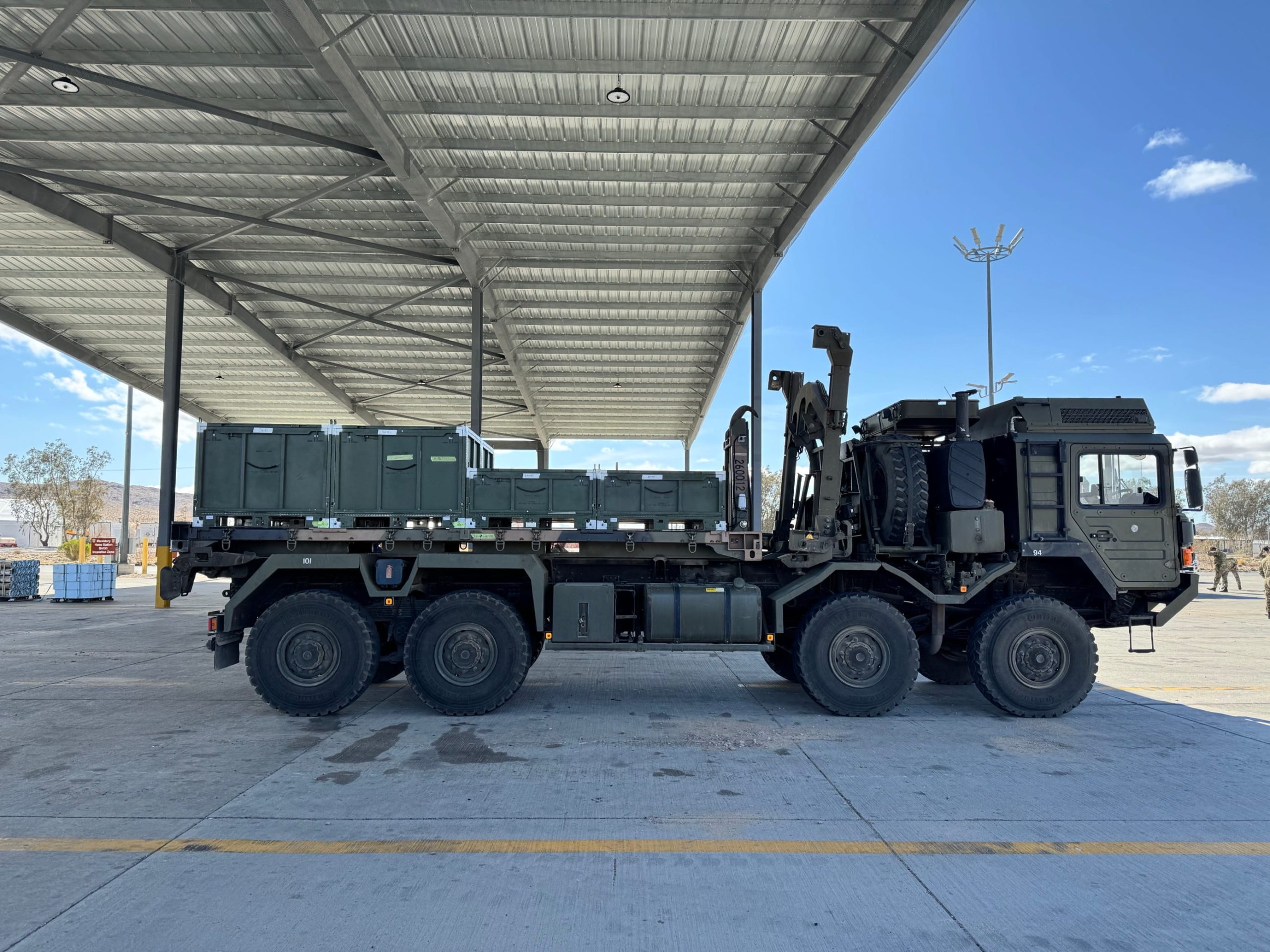
For years, the Australian Army’s Joint Modular Intermodal Logistics System (JMILS) has moved stores and equipment efficiently through the supply chain on modular, interconnectable packaging compatible with the Army’s Land 121 vehicle fleet. What it couldn’t do was tell anyone where a specific piece of that packaging actually was, or what condition it was in, once it left the depot. That gap became the starting point for a Defence Innovation Hub program that ran across two phases, from a 2019 proof of concept to a full-scale deployment completed in 2025, and it’s now been independently confirmed operating with a second nation’s army.
The problem: packaging with no visibility
JMILS platforms, the physical packaging and cargo-carrying systems built by ECLIPS Engineering, are designed to be modular, scalable and interconnectable, moving efficiently through the Defence supply chain on the Army’s medium and heavy vehicle fleets, including the HX77 Improved Load Handling System (ILHS) truck and the 40M.
What they lacked was any way to be tracked once they entered the supply chain. Logistic Delay Time and Administration Delay Time, the gap between an asset physically existing and someone actually knowing where it is, was directly undermining Operational Availability rates and driving up through-life support costs.
Phase Two: proving the concept (2019–2020)
Hammerstone’s response, run under Defence Innovation Hub contract DIH P18-750856 from October 2019 to December 2020, integrated location and condition monitoring sensors onto JMILS platforms using intrinsically safe RuBee magnetic near-field communications from Visible Assets. This was the first proof that JMILS packaging could be digitally tracked at all, a deliberately contained trial rather than a fleet-wide rollout, aimed at isolating and reducing the Logistic Delay and Administration Delay that had been eating into Operational Availability.
Phase Four: scaling to full deployment (2023–2025)
Proving the concept in Phase Two earned funding for full-scale delivery under a phase 4 contract. Under Defence Innovation Hub contract DIH P18-750856P4, running from February 2023 to March 2025, Hammerstone delivered the complete D-JMILS capability: asset identification and in-transit visibility; environmental condition and handling monitoring; LTE, Iridium and tactical radio communications; secure cloud services; intrinsically safe asset tags suitable for explosives and fuels; and integration with ERP software and Battle Management Systems.
The result contributes directly to the Recognised Logistics Picture. As Hammerstone’s own engineering team describes the two-phase arc: “Systems engineering and product development across two DIH programs, from concept and design through to delivery of an in-transit visibility system. Demonstrates the ability to take a concept from innovation to ADF-deployed capability.”
How D-JMILS actually works
D-JMILS tags JMILS platforms and payloads using RuBee (IEEE 1902.1) magnetic near-field technology, the same intrinsically safe approach used in Hammerstone’s UID/AIT work, chosen specifically because it penetrates metal containers and is safe to use on ordnance and near fuel, where standard RFID cannot operate.
That safety claim isn’t just a vendor assertion, it’s been independently tested. In 2012, the US Department of the Navy certified RuBee tags, handheld readers and base stations with a zero Safe Separation Distance for both HERO SAFE and HERO UNSAFE ordnance, tested against MIL-STD-464C, where comparable wireless technologies such as RFID, Wi-Fi and Bluetooth typically require a 3 to 12 foot separation. Asset data is transmitted via 4G/LTE, Iridium satellite, Wi-Fi or tactical radio networks to a user interface that can run on-premise or as a cloud service, and integrates with ERP systems such as SAP and Battle Management Systems such as Systematic’s SitaWare.
In field use, the resulting automated audits have achieved a 100 per cent read rate, a meaningful claim given how much of the original problem was assets going unaccounted for.
Proven in coalition operations, and independently confirmed
D-JMILS was demonstrated in coalition conditions at Project Convergence Capstone 5 in 2025, a US-led experimentation exercise at Fort Irwin, California that brought together Australian, US, UK, Canadian, New Zealand and French forces. The specific problem it addressed was concrete rather than theoretical: as Captain Shane Allen of 17th Sustainment Brigade described one scenario, a single asset moved as a Nepalese driver operating a UK vehicle, carrying an Australian container rolling off platform (CROP) system, inside a French ISO shipping container. Tracking that asset in real time, across four nations’ equipment, is exactly the in-transit visibility problem D-JMILS’s RuBee-tagged platforms exist to solve.
D-JMILS gave Australian, US and UK forces in-transit visibility of stores and ammunition, across coalition assets, providing automated identification and in-transit visibility that followed the asset regardless of which nation wound it, who was moving it, or what container it was travelling in.
As Hammerstone General Manager Matt Hanlon described the underlying capability, it delivers “a comprehensive deployed logistics management system that operates in DDIL environments, improving situational awareness and decision support from tactical to strategic levels.”
The full deployment, including ReadyFleet™’s role fusing this data into a shared Logistics Common Operating Picture, is covered in our PC-C5 case study.
Built to integrate, not replace
D-JMILS doesn’t ask an organisation to replace its existing logistics, ERP or command systems. It sits alongside SAP, ReadyFleet™ and SitaWare via secure cloud services, supplying the in-transit visibility layer those systems don’t have on their own, and feeding directly into the Recognised Logistics Picture. For a Defence customer already running SAP and a Battle Management System, that’s the difference between a system overhaul and a capability that plugs into what’s already there. Full technical detail on that integration approach is on the D-JMILS product page.
Frequently Asked Questions
What’s the difference between D-JMILS Phase Two and Phase Four?
Phase Two (2019–2020) was a contained proof of concept, proving that JMILS packaging could be digitally tracked at all. Phase Four (2023–2025) scaled that into full deployment across all six capability elements, funded on the strength of what Phase Two demonstrated, skipping the typical Phase Three.
Who manufactures the physical JMILS platforms that D-JMILS digitalises?
ECLIPS Engineering builds the modular, intermodal packaging and cargo-carrying platforms. Hammerstone’s role is integrating the sensing, identification and communications layer onto that existing platform. Hammerstone has designed D-JMILS to be OEM agnostic to the Packaging, Handling, Storage and Transport systems used.
Has D-JMILS been used outside Australia?
Yes, D-JMILS played a key role as part of Project Convergence Capstone 5.
Does D-JMILS work in containers and near explosives?
Yes, this is the specific reason RuBee was chosen over standard RFID. RuBee’s magnetic near-field technology penetrates metallic containers and is intrinsically safe for use on ordnance and near fuel stores.
Is D-JMILS Defence-only?
No — while designed for Defence and coalition operations, it is equally applicable to industrial and government logistics where visibility and accountability matter. D-JMILS was developed specifically for ADF intermodal logistics platforms and has been proven in coalition operations. However, the underlying technology — RuBee AIT, environmental monitoring, secure cloud integration and ERP connectivity — is equally applicable to industrial and government logistics operations where high-value or regulated assets need to be tracked across complex or geographically distributed supply chains.
What started as a contained proof of concept on a handful of JMILS platforms in 2019 is now a fully deployed capability, for the ADF’s intermodal logistics.
Want to know what an in-transit visibility program could look like for your logistics chain? Talk to us.
External sources
Related reading
- D-JMILS — the full product page, including technical capabilities and FAQs
- Project Convergence Capstone 5 (PC-C5) case study
- UID / AIT
- ReadyFleet™
- Sense & Respond Logistics