
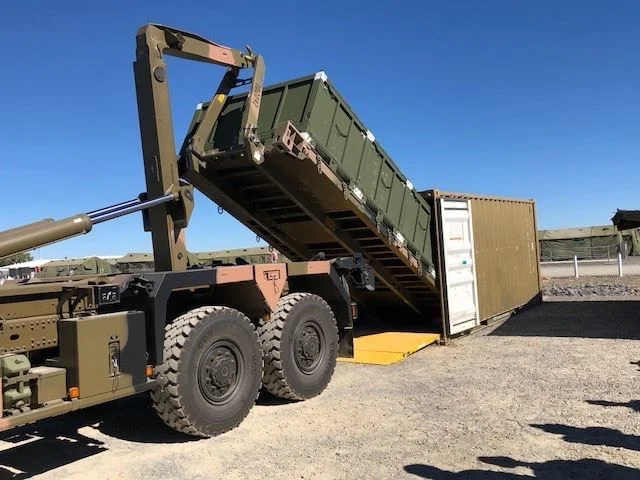
The 2026 Australian Army Land Environment Working Group (LEWG), held in Canberra on 17 and 18 August, gave industry another update on Army’s capability priorities. One message was familiar: the need for a standardised, modular logistics system that can move materiel from the strategic base to the tactical edge.
It isn’t a new requirement. As Hammerstone Managing Director Matthew Shea noted following the event, the case for a Modular Logistics Distribution System (MLDS) traces back to 2015, when RPDE Task 59 first explored a Unit Load Carrier (ULC).
At the 2019 LEWG, then Director Combat Service Support Colonel Amanda Fielding called for standardised Packaging, Handling, Storage and Transport (PHS&T) across the land logistics system.
Seven years later, at LEWG 2026, Colonel Harvey French again reinforced the direction Army wants to take through adoption of the Modular Logistics Distribution System (MLDS) using the same slides from 2019.
The requirement has been clear for close to a decade. What’s changed is how little time there is left to keep discussing it instead of delivering it.
What MLDS needs to include
Based on the direction reinforced at LEWG 2026, MLDS brings together a set of standardised components and capabilities:
- ISO 1CC containers
- Container Roll Out Platform (CROP)
- Joint Modular Intermodal Containers (JMIC)
- Unique Identification (UID)
- Automatic Identification Technology (AIT)
- Inventory and in-transit visibility
- Condition and configuration monitoring
- Enterprise and tactical information systems
Individually, these are largely proven technologies, and Australia already has industry capable of delivering substantial parts of the system. That’s why the conversation at LEWG has shifted from whether MLDS is needed to how it actually gets built.
More than compatible containers
The risk, as Shea put it, is treating MLDS as “a collection of compatible containers and platforms.” Standardised physical interfaces solve part of the problem, but modular packaging without a digital layer is still just packaging.
MLDS should instead become part of the physical foundation of a digital Defence supply chain, where every item, container and platform carries a trusted digital identity, answering:
- What it is
- Where it is
- What it contains
- Its configuration and condition
- Whether it’s available
- Whether it’s ready to move, sustain or fight
Connect that identity and condition data from the factory, through the strategic base and distribution network, to the tactical edge, and the result is a Recognised Logistics Picture nested within the Common Operating Picture (COP). That’s a genuinely different outcome to a warehouse of standardised boxes, and it’s the same shift from static planning to continuous sensing that underpins Hammerstone’s Sense and Respond Logistics model.
The pieces already exist
This is where the MLDS conversation connects directly to capability already being delivered in the Australian market.
Standardised, machine-readable identification, the “what it is” question, is exactly what UID/AIT solves. Hammerstone has been the Australian Defence Force’s prime UID/AIT supplier since 2021, extending standardised identification across more than 300,000 items for Army and Air Force.
In-transit visibility of modular, intermodal packaging, the “where is it and what condition is it in” question, is the specific problem D-JMILS was built to solve. D-JMILS uses AIT and UID tagging designed to function inside containers and metallic environments, exactly the conditions JMIC and CROP-based systems create, and feeds that location and condition data into the broader logistics picture as assets move.
ReadyFleet™ then fuses that data with enterprise and command systems, connecting to platforms like SAP through Hammerstone’s SAP & Cumulocity Integration work, so the “enterprise and tactical information systems” requirement doesn’t mean replacing what Defence already runs.
None of this makes MLDS a solved problem. But the digital foundation it needs, identity, visibility, condition monitoring and enterprise integration, isn’t a research question. It’s a delivery question.
From intent to implementation
As Shea argued, the next step isn’t another round of exploring every possible option. It’s agreeing the standards, publishing the interfaces, and letting industry innovate against them.
“The strategic environment does not give us another seven years to keep discussing the same requirement.” – Matthew Shea, Managing Director, Hammerstone
Standardise. Automate. Integrate. Synchronise. Decide. Factory to firing point, edge to enterprise, that’s the distance MLDS needs to close, and the technology to close it already exists.
Ready to talk about what a digital foundation for MLDS could look like for your program? Talk to us.
Frequently Asked Questions
What is MLDS (Modular Logistics Distribution System)?
MLDS is a proposed standardised, modular packaging and distribution system for the Australian Army, using components such as ISO 1CC containers, Container Roll Out Platforms (CROP) and Joint Modular Intermodal Containers (JMIC) to move materiel from the strategic base to the tactical edge.
Why does MLDS need a digital layer, not just standardised containers?
Standardised physical interfaces solve compatibility between platforms, but without identity, location and condition data attached to each item and container, planners and commanders still can’t answer basic questions like what’s available, what condition it’s in, or whether it’s ready to move.
How does this connect to Hammerstone’s existing capabilities?
UID/AIT, D-JMILS and ReadyFleet™ already address the identity, in-transit visibility and enterprise integration requirements a digitally enabled MLDS would need, using technology already proven in ADF service.
What happened at LEWG 2026?
The 2026 Australian Army Land Environment Working Group, held 17 to 18 August in Canberra, is Army’s primary industry engagement forum. It reinforced Army’s direction on MLDS, a requirement industry has heard consistently since at least 2019.
Related reading
- Sense & Respond Logistics — the full capability page, including technologies and FAQs
- UID / AIT
- D-JMILS
- ReadyFleet™
- SAP & Cumulocity Integration

